Single In The City: The Joy Of Dating Yourself
Dr. Freya Bajandouh, PhD
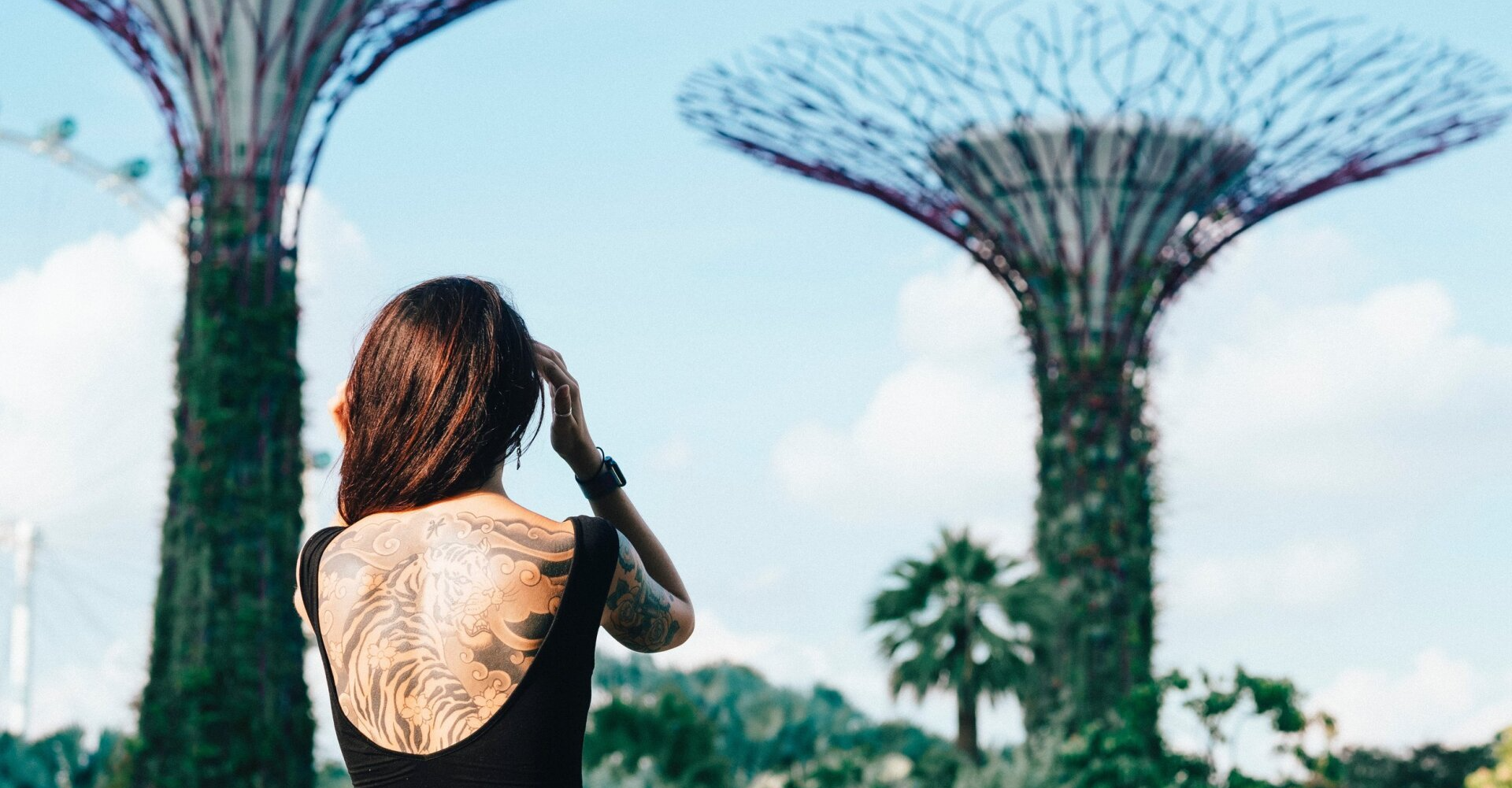
A woman with a tattoo on her back is standing in front of two trees.
Being single is now viewed as in vogue; or so we are told by the new generation of feminists who are waving goodbye to the old-fashioned ideas of settling with a husband before they hit 30, and hello to a life driven by their own dreams and desires.

This is great news for those who are content to live a single life, but what about the women who are looking to settle, and who feel their single status is a misfortune?


Being single and living in a city such as Singapore offers many rewards, such as having the freedom to pursue your own interests, appreciating quiet moments of solitude and learning how to enjoy your own company. However, being single in the city can also feel isolating.


It is likely your weekends are spent at parties surrounded by couples, your social media is full of engagements, weddings and babies, and when you drag yourself to family events, you get the dreaded “why aren’t you married yet?” question.


Dating for women can be difficult in a place like Singapore. If you are an expatriate, you will have found that many expatriate men have come here with their partners. For those men who have arrived single, the party lifestyle and staying single can be all too enticing.


Finding a man who is looking to settle down can feel like looking for a needle in a haystack.


Even when a woman finds a man who is looking for something serious, there is always the risk they will be whisked away to another country due to work or family commitments. It can be confusing and disheartening to be living in such a transient city.


While you can increase your chances of meeting the right man, there is a large element fate, chance and divine intervention in whether you will meet ‘Mr Right’. However, you do have some influence over these outcomes, so let’s focus on gaining power over things you can change and let the rest happen naturally.


You can influence your happiness because ultimately, you are in control of the choices that lead to it.


Happiness is described as ‘the overall experience of pleasure and meaning’. Meaning is needed to give you a sense of purpose in life, and pleasure provides a sense of joy.


If you want to feel happier, add pleasure or meaning to your life. The best thing about this? You do not need another person to help you.


Here are 4 ways in which you can increase your happiness while you wait for Mr Right to come knocking at your door.


1. Why wait to date a man? Create your own dream dates.


Why are you waiting for someone else to cook your favourite meal, light candles, play your favourite music or to run you a luxurious bubble bath? Do it for yourself and enjoy being cared for by the one most important person in your life - you.


Me-dates do not need to be kept at home. Doing things alone can be incredibly uplifting as you come to enjoy your own company. Start with a coffee alone, then go for lunch. Build up your confidence until you feel comfortable to dress-to-impress and eat at a fancy restaurant - the difference here is that the only person you want to impress is yourself.


Why stop at simple date nights? Book that trip you have been dreaming of and join the thousands of people who are traveling solo. A study released in May 2018 found that “there is also a surge in solo travel.. with 40% of baby boomers having taken a solo trip in the last year, and a further 21% planning to take one in the future”.


By going out of your way to look after yourself, you begin to cultivate your self-esteem. This is something that many people overlook but it is one of the most significant aspects to feeling fulfilled.


It is important that you can rely on yourself to nurture your self-esteem and not become reliant on the opposite sex to make you feel worthy. You ARE worthy, and the better your treat yourself, the more you will start believing it.


2. Mates-dates will have you laughing so hard your tummy hurts.


Gather your girls for a pizza night, evening of cocktails or a healthier option such as a long walk or yoga class. Make it even simpler and take your best friend out on a date of their dreams. Making others happy will in turn create that warm fuzzy feeling for you too.


The support of your friends may enable you to try something more adventurous such as a new exercise class or learning a new skill. Weekends away exploring nearby attractions adn trips abroad are also a great way to connect with friends while at the same time exploring the world.


You may have heard the phrase, “friends are the family you choose for yourself”. This illustrates the importance of nurturing your friendships and keeping the connections strong. This can be even more significant for expatriates who live many miles from their family and require a strong support system around them in their new home country.


3. Focus on what you have, not what you do not have.


It is easy to look at people in relationships and wish that could be you. When you find yourself doing this, I urge you to focus not on what is lacking in your life but instead focus on what you do have.


Gratitude is repeatedly hailed as the secret to happiness and it is so for a reason. When you feel you are going down a negative thought pattern, make a list of 10 things you are grateful for. The list can be mental, or you can write it down. Personally, I prefer to write it down as this helps to cement it in my mind. Your list can include small details such as being grateful someone held the door for you at work, or it can include bigger details such as having supportive and loving family/friends.


4. Take the time and energy to develop self-awareness.


As a therapist, I am naturally a big proponent of therapy. It can be very beneficial to spend time with a therapist and explore exactly who you; what are your desires, values and goals and how can you ensure you are fulfilling these in your life.


Self-awareness can also be fostered through meditation. Sit comfortably, close your eyes and observe your thoughts. Do not try and change them, or judge them, just observe them. It can feel strange at first, but try to embrace all of the emotions you are feeling. Having a meditation practice can be an incredibly self-educational experience when it is practiced consistently.


The ideas I have provided here I recommend to anyone, no matter what your relationship status may be. The outcomes of the above actions are increased gratitude, understanding and acceptance, which are the pillars for feeling fulfilled.


Single in the City: The Joy of Dating is the first in a series of blog posts aimed at supporting those who are finding it hard living as a single person. If this resonates with you, do not hesitate to contact Dr. Freya who specialises in self-esteem and can support you to overcome any negativity you are experiencing.


About the Author: Dr. Freya strongly believes in the science of Positive Psychology and uses her wealth of knowledge in this area to help clients overcome issues they face, enabling them to feel more positive towards themselves and their lives. Freya has a PhD in Psychology, is a qualified Yoga Teacher, and has completed courses in Meditation and Buddhist Studies. Read Full Bio >

By Aki Tsukui - Director of Wellness / Leadership & Systemic Coach June 2, 2026
In today’s performance-driven world, identity is often shaped by what we do, how we deliver, and how we are perceived. We become known for our roles, our output, our ability to keep going.But beneath this constructed identity lies a quieter question: Am I living and leading as a whole human being? This is where the conversation on identity begins to shift from definition to integration. The Hidden Cost of Fragmentation Many individuals move through their professional lives in subtle disconnection. The mind is engaged - analyzing, solving, producing. The body is overridden - pushing through fatigue and tension. Emotions are managed or suppressed. And a deeper sense of purpose is often left out entirely. Over time, this fragmentation accumulates. It begins to show up as fatigue, reduced clarity, emotional depletion, or a gradual sense of disengagement. In more visible forms, it is named as burnout. As this experience becomes widespread, it calls for a different understanding. Burnout is no longer best seen as an individual issue. It is a signal of accumulated strain, and often, of how work systems are designed around disconnection. This is what is opening new conversations in leadership today. A Reframing of the Conversation In a recent workshop. The Workplace Reset, with leaders and HR professionals, a different kind of dialogue began to emerge. Instead of asking, “How do we fix burnout?”, the question deepened: What are we asking of people and from which parts of themselves are they operating? There was a clear shift. Burnout began to be seen as organizational feedback, not personal failure. Wellbeing moved from a benefit to a foundation for performance. And resilience was reframed: not as silent endurance, but as the ability to stay connected while navigating challenges. At the heart of these reflections was a simple realization: People do not show up to work in parts. They show up as whole human beings. The Four Dimensions of Being To understand identity more fully, we must recognize the dimensions that shape our experience: • Mind — thoughts, logic, and sense-making • Body — physical state and lived experience • Emotion — inner and relational world • Spirit — values, purpose, and alignment When these operate in isolation, we may still function but often at a cost. Clarity becomes forced. Energy becomes depleted. Decisions feel misaligned. But when these dimensions integrate, something shifts. There is steadiness. Clarity becomes more natural. And a sense of coherence emerges in how we think, feel, and act. This is not about adding more. It is about reconnecting what has been separated. Identity as a Felt Experience Identity is often approached as something we define intellectually through titles or strengths. But true identity is not something we arrive at through thinking alone. It is something we experience . It is felt when actions align with values. When the body is not in resistance to the pace we keep. When emotions are acknowledged rather than suppressed. When work connects to meaning. The body plays a crucial role here. It holds signals the mind may override: tension, fatigue, ease. These are not inconveniences, but information. When we begin to listen, not just cognitively, but somatically, we access a more honest relationship with ourselves. From that place, identity becomes less about performance, and more about alignment. Embodied Leadership This shift toward integration is especially relevant in leadership. Traditional leadership has emphasized control, decisiveness, and cognitive strength. While important, these are no longer sufficient on their own. What is needed is embodied leadership . The capacity to lead from internal coherence. To stay grounded under pressure. To acknowledge emotions without being overwhelmed. To think clearly without disconnecting from intuition. To act in alignment with values, not just expectations. Leaders who operate this way shape environments. Where people feel safe enough to be honest. Where challenges can be named. Where wellbeing supports performance. In such spaces, people are not required to fragment themselves to succeed. They are able to show up more fully and contribute more meaningfully. Integration as Practice Integration is not a one-time insight. It is an ongoing practice. It requires pause withinmovement. Awareness within action. And the willingness to notice when we are out of alignmentand return. This may look like: • Checking in with the body, not just the mind • Noticing emotions without suppressing them • Creating small moments of stillness • Reflecting on whether decisions feel aligned These simple practices begin to shift how we relate to ourselves and our work. Harmony, Not Perfection Integration does not mean being perfectly balanced. Harmony is dynamic. There are moments when the mind leads, and moments when the body needs rest. Times when emotions surface, and times when purpose provides direction. The key is not control, but connection. To remain in relationship with all parts of ourselves and trust the intelligence within that allows us to respond with coherence. This is where resilience takes on a new meaning: Not endurance without struggle, but the ability to stay connected while moving through it. A New Way Forward As organizations navigate increasing complexity, there is an opportunity to redefine what it means to perform and to lead. Not through further optimization of parts but through integration of the whole. Because the most sustainable way of working is not built on pushing harder. It is built on coherence. On creating conditions—within individuals and systems—where people do not have to disconnect in order to function. Where identity is not something we perform, but something we live. And where, in returning to wholeness, we unlock not only wellbeing but a deeper, more grounded form of leadership.
By Ines Palomera June 2, 2026
Every year, Pride Month invites us to celebrate LGBTQ+ identities, communities, histories, and the people who came before us. Yet beyond the colours, visibility, and public celebrations, Pride also invites us into a deeper reflection: what does it mean to belong to ourselves? What does it mean to be seen, not only by the world around us, but by the people we love, the communities we live in, and the systems that shape our everyday lives? From a marriage and family therapy perspective, identity is never formed in isolation. We do not simply wake up one day with a complete understanding of who we are. We become ourselves through relationships. We are shaped by our families, cultures, religions, languages, gender expectations, friendships, migration stories, and the places we learn to call home. For many of us, identity is not one single answer, but rather a collection of many parts of ourselves trying to coexist. This is especially true in a city like Singapore. Singapore is a place where so many cultures, religions, languages, and ways of being exist side by side. There is something deeply precious about walking through a city where people express themselves through food, dress, language, faith, family traditions, and community rituals in so many different ways. In that diversity, we are reminded that identity is layered. We are not only one thing. We may be queer, Singaporean, foreign-born, religious, spiritual, neurodivergent, multilingual, a parent, a partner, a child, a professional, a caregiver, or all of these at once. And yet, for LGBTQ+ individuals, couples, and families, the experience of identity can also carry tension. In Singapore, meaningful progress has been made. The repeal of Section 377A marked an important step in the journey toward greater dignity and recognition. At the same time, many LGBTQ+ people continue to live with the reality that not all relationships, families, and identities are fully recognised or protected in the same way. Both truths can exist together: we can honour the progress that has been made, while also acknowledging the battles that are still being fought. Pride, then, is not only about celebration. It is also about resilience. It is about the courage to name oneself honestly in a world that may not always make that easy . It is about the quiet strength of a young person trying to understand their gender or sexuality. It is about the couple who builds a life together even when their relationship is not always seen by the law. It is about the parent who chooses love over fear. It is about the friend who listens without judgment. It is about the family member who is still learning, but chooses to remain present . It is about the communities that create spaces where people do not have to shrink themselves to be accepted. A few weeks ago, I had the chance to attend an anniversary event at Proud Spaces, a community space in Singapore that brings together LGBTQ+ people, allies, and organisations. What stayed with me was not only the event itself, but the feeling of being in a room where people were actively building belonging. These spaces do not appear by accident. They are created by people who give their time, energy, care, advocacy, and often their own lived experience so that others may feel less alone. Spaces like these matter because tolerance is not the same as belonging. To be tolerated is to be allowed to exist. To belong is to feel that your existence has a place . It is to walk into a room and feel that you do not need to hide the parts of yourself that make others uncomfortable. It is to be able to speak, dress, love, move, pray, parent, and live with a sense of dignity. In therapy, we often see how painful it can be when parts of a person’s identity have been silenced for too long. Shame does not only live inside individuals; it is often created and sustained in relationships and systems. When someone repeatedly receives the message that a part of them is too much, too different, too inconvenient, or too difficult to understand, they may begin to disconnect from themselves. Healing often begins when that person is met differently: with curiosity, validation, safety, and respect. This is why Pride Month is relevant to all of us, whether we identify as LGBTQ+ or not. Pride asks us to reflect on the spaces we create. Are we making room for people to be honest about who they are? Are we listening when someone tells us their name, their pronouns, their story, their family structure, their faith, their culture, or their fears? Are we allowing the people around us to be complex, or are we asking them to fit into categories that feel more comfortable for us? It also asks us to turn inward. Which parts of ourselves have we learned to hide? Which parts have we been taught to minimise? Where do we feel most whole? Who are the people, communities, and spaces that allow us to breathe more freely? For some, Pride may be loud and visible. For others, it may be private and quiet. It may look like attending a community event, wearing something that feels true, holding a partner’s hand, coming out to one trusted person, reconnecting with chosen family, or simply looking at oneself with a little less shame than before. We stand on the shoulders of those who fought before us, and we continue that work in the way we show up for one another today. In Singapore, more and more spaces are being created for people to feel validated in their identities, relationships, cultures, beliefs, and ways of being. These spaces matter because belonging is not built only through laws or public recognition, but also through the everyday experience of being met with care, curiosity, and respect .  At Counseling Perspective, we have worked hard to reflect this same spirit within our own team. Our counsellors bring together a multitude of backgrounds, cultures, beliefs, origins, and specialisations, allowing us to support people whose stories, identities, and needs may look very different from one another . Whatever your story, it has a place with us. If you are exploring your identity, struggling with your sense of belonging, or simply needing a space where you can feel more fully seen, our team is here to walk alongside you and help you find the emotional support that feels right for you. Resources in Singapore For those looking for LGBTQ+ affirming community spaces, support, or further information, the following organisations may be helpful: · Proud Spaces — A community space for LGBTQ+ people, allies, and organisations in Singapore, focused on connection, collaboration, and belonging. Visit website · Oogachaga — An LGBTQ+ affirming community-based organisation offering counselling, emotional support, and professional resources. Visit website · Oogachaga WhatsApp Counselling — A free and confidential WhatsApp counselling service for LGBTQ+ people in Singapore. Visit website · The T Project — Singapore’s first and only social service for the transgender community, including shelter and community support. Visit website Sayoni — A Singapore-based feminist organisation advocating for queer women, including lesbian, bisexual, transgender, and queer women.
By Aki Tsukui Director of Wellness - Leadership & Systemic Coach, Transformational Facilitator April 30, 2026
In my recent work, I’ve begun to notice a pattern. Many women across different stages of life are quietly struggling. Not with something obvious, but with something much harder to name. Friendship. On the surface, life looks full. There are social circles, dinners, invitations, people to message on a Friday night. There is connection. And yet, beneath that, there is a quiet, persistent feeling: Something doesn’t feel quite right. The Reality Beneath Connection So many friendships begin through circumstance. We meet people through work, shared environments, mutual communities, or simply being in the same phase of life. And naturally, connection forms. These relationships can be warm, supportive, and genuinely meaningful. They often arrive at a time when we need them most: when life is shifting, when we are finding our footing, when we don’t want to feel alone. But there is something many women don’t say out loud: Some friendships are built on situation, not alignment. And over time, that difference begins to surface, not as conflict, but as a quiet undercurrent. The Discomfort That’s Hard to Explain What I hear from female clients is rarely dramatic. It’s the sense of not being fully themselves. Of subtly managing energy instead of simply being. Of leaving an interaction feeling slightly drained, without knowing why. Nothing is obviously wrong. No one has done anything hurtful. In fact, these friendships often include kind, thoughtful people who have shared important moments with us. Which is exactly why it’s so confusing. Because when nothing is broken, it becomes harder to trust the feeling that something isn’t quite right. When Gratitude Silences Truth Many women carry a deep sense of appreciation for the people in their lives. These friendships may have supported them through transitions, offered belonging, or simply been there when it mattered. So, when discomfort arises, it is often softened: I should be grateful. Maybe I’m overthinking this. But gratitude and misalignment can exist at the same time. You can value what a friendship has given you and still feel that it no longer reflects who you are becoming. The Quiet Cost Because there is no clear reason to question the relationship, the adjustment often happens internally. It looks like small things: holding back certain thoughts, avoiding deeper conversations, feeling slightly “on” instead of at ease. Even a quiet sense of relief when plans fall through. Individually, these moments seem insignificant. But over time, they create distance, not from others, but from yourself. Why We Stay Friendships are rarely just about one person. They are intertwined with shared circles, familiar routines, and a sense of belonging that extends beyond a single connection. Which is why stepping back can feel so much bigger than it seems. There is also the quiet weight of beginning again. Building new connections asks for openness. Letting go, even with care, asks for truth. And so, many women stay, not because it feels right, but because it feels easier than facing what change might require. The Quiet Turning Point And yet, something begins to shift. Not suddenly, but gradually. A quiet awareness surfaces: I don’t think I can keep showing up like this. This isn’t about blame or judgment. It’s about noticing yourself more honestly. Where you feel open, and where you feel restricted. Where connection flows, and where it feels effortful. Redefining Connection The shift doesn’t need to be dramatic. It often begins in small, almost invisible ways. Speaking a little more honestly. Setting a gentle boundary. Choosing where you place your time and energy with greater intention. And slowly, things begin to change. Some friendships deepen because they can meet you there. Some soften into something lighter. Some quietly fall away. A Different Kind of Belonging What many women are truly longing for is not more connection, but more alignment within connection. Not just people to spend time with, but spaces where they can exhale. Where nothing needs to be filtered. Where they can be fully themselves without effort, without adjustment. If this resonates, you are not alone. This is not about being ungrateful or difficult. It is about becoming more attuned to yourself, your energy, and your truth. And often, that awareness begins quietly in the middle of a conversation, after a dinner or even in a feeling you can’t quite explain. The question is not, Are these the right friends? But: Where do I feel most like myself and am I allowing myself to move closer to that? Because true belonging isn’t created by proximity. It’s created in the moments where you no longer feel the need to edit who you are and realise you don’t have to leave parts of yourself behind to be accepted. And if something in you is beginning to notice this quietly, gently, it may be worth giving it space. Not to rush into change, but to listen more closely to yourself and to what more aligned, honest connection might begin to look like in your life.